Showing posts with label real life. Show all posts

Sunday, October 7, 2012

Thinking about retirement

So as part of the standard paperwork overload of starting a new position, I had to fill out paperwork relating to my retirement account.  In both this new position and the position I had last year, I had two options: pension or private.

Unlike my old university, which let you choose one and then swap 5 years down the road if you so chose (one time only), at my new university, you have to choose one within 6 months of starting, and you can never, ever, ever (ever ever) go back.  Even if you leave the university and come back later, you're stuck in that same original choice.

The pension plan is typically a good deal if you plan to stay with that university (or within the state university system) for the rest of your career.  The way the pension plan works (at least at my new university), is you put in a set amount of your paycheck (~10%) into the pension plan (pre tax), and when you retire, they calculate how much your pension will be based on a special formula.  From what I understand, this formula takes into account how many years you've worked for the pension system (30 years seems to be what's needed to get the 'maximum' benefit), an average of your highest 3(?) salaries, and how old you are. So hypothetically, if you worked 30 years paying into the pension system, was of retirement age (~67ish?), and your highest 3 years of salary were $100,000, you'd end up somewhere with $80,000/year in pension until you croak.  If you worked fewer years, retired earlier, or made less salary, your pension would be lower.  Still, the benefits are largely guaranteed, so once you put in your time, you can sit back and let the cash roll in.
...So that seems like a pretty sweet deal.

The 'alternative' retirement program worked as follows: You put in the same amount (pretax) that is withheld from the pension (~10%), but that goes into a private retirement account that you own.  You can choose 3 providers to manage that account (e.g., TIAA-CREF), and the university will put in a matching amount of ~5%.  So in essence you end up with ~15% of your salary going into your retirement account each year, though it only costs you ~10% of your salary to do this (the rest is matching).  You are 100% vested from the start, which means that's your money (both your own and the matching) if you ever leave the university.  Your retirement fund grows over the years through your contributions, university matching, and as the markets increase in value.  Meanwhile, you have a few options of how to use your funds, such as in money market, real estate, bonds, stocks, etc.  All of these are mutual fund type investments, so you don't actually put your money in specific homes (if you choose real estate) or specific stocks, instead you buy shares in a mutual fund that uses their resources to purchase a number of different investments within that field (e.g., many different stocks).  From all of the literature I've seen, if you have a balanced investment strategy you can reasonably expect to earn 5-7% per year on your money (whether that holds up in real life, who knows).  You can't withdraw your retirement funds before you retire, otherwise you pay a HUGE amount of taxes/penalties on it.

The key things I had to consider when choosing between these options were:
1. Do I think the pension plan will still be around in ~35 years?  (Most definitely)
2. Do I think I'll stay with the same university/university system to ~35 years (Hopefully?)
3. Would I get seriously screwed over if I left the system early, such as not getting tenure or taking another position elsewhere in 10 years (Yes)
4. Do I expect to retire on time (late 60's) to start collecting the pension? (Maybe)
5. Do I expect to live a really long time in retirement? (Probably not)

So while I like my new position, and I hope to be at the same university until I retire, I ended up choosing the 'alternative' plan.  

There were a few reasons I did this:
1. I simply can't predict the future, and it seems like too much of a gamble to plan on being at the same university for 35+ years.
2. I'm not sure I'd want to retire when I hit mid/late 60's, since being a professor is a pretty sweet gig, and once you make full professor, you can pretty much do whatever you want in terms of research, and you always get summers off, and if you have a 2/2 load, the teaching is very reasonable.
3. I'm not convinced I'll live until I'm 80 or 90, so I'd rather have something that would go to my wife/children if I croak sooner rather than later.
4. I'm untenured, and while I'd like to think I'll get tenure at my new university, that decision is still 5+ years away.  If I don't get tenure, and I have the pension plan, my options would be to go to another state-university school (hard to do, unlikely to be a Ph.D. program, likely a big hit in salary), or take a HUGE hit on my retirement account and leave the system.
5. Even if I get tenure, if I wanted to move on to someplace new in 10 or 15 years, the pension would seem like a pair of golden handcuffs.  Good to have, but making it too costly to go anywhere else.

Another thing I had to consider was that under the university/state system, I don't pay social security tax (yay!), but I also wouldn't GET social security when I retire (boo!).  I fully expect social security to have crashed and burned well before I retire, or at best, be severely eviscerated, so I'm not too worried about that.  It basically gives me 4-6% more in my salary that I could use for a supplemental retirement fund (or beer).

Hopefully I'm making the right decision.  I expect that the pension system might have been a slightly better choice, since I don't plan on leaving the new university, but the alternative system seems like the safer of the two.  There's nothing I can do about my choice now (since, again, the only way to change your choice is with a time machine), so I guess I should just not worry and work instead on getting tenure.

...Of course, in 40 years if I'm stuck eating cat food because the market crashed and I don't have social security, I'm going to look back on this post and be pretty pissed.
While Professor Fluffykins' 401k crashed and burned,
the prospect of having to eat cat food in retirement
doesn't seem all that bad to him.

Sunday, August 28, 2011

Having a creative outlet outside of academia

Yes, when I get stressed, I basically
turn into Tweak from Southpark.
One of the things I think is incredibly important for making it through grad school (and hopefully through the tenure track) is to have a creative outlet that doesn't involve academia.  These outlets let you get away (even temporarily) from thinking about classes, about the dissertation, about teaching, about publications, about the job market, and all of those other things that caused my eyelid to twitch from thinking about them too much. (Seriously, the eyelid twitch is God's way of saying "Look, you've got to calm down before I give you a stroke.")

When I was in grad school I had a number of different hobbies, some short-lived, some not, that let me escape from the grad school, homework (when I still had classes), research, and academia in general.  Due to my self-diagnosed hobby A.D.D., the assortment of things I used as creative outlets and general stress relievers was pretty varied. Here's a list of three things I did (and may still do from time to time), along with the reasons I found them to be enjoyable, and things to consider if you wanted to take any of these up in the future.

This is why I hate swimming.
Thanks Speilberg.
1. Kayaking
My wife and I took up kayaking after her parents took us kayaking a couple times during a summer visit. While I am not a strong swimmer, and generally am terrified of swimming in natural bodies of water (holla back if you saw Jaws as a six year old as well!), I found I actually enjoyed floating on top of the water, and being able to easily control where the kayak went.

The best part of kayaking, I think, is being forced to go out into nature and actually do something.  Kayaking gets you out of the house, let's you see and explore the natural surroundings in your area, and is very relaxing. Note that I am not talking about whitewater kayaking, which requires a helmet, fast moving water, an updated will, and the ability to not freak the f*ck out when you flip over and are strapped into your death trap of a boat. I don't think I would find that relaxing, and since I'm allergic to drowning, I don't think I'll be trying it anytime soon. Rather, I'm talking about kayaking on slow moving rivers and calm lakes.

Yeah... not this kind of kayaking...
The worst thing about kayaking is it's very weather dependent, and in the northeast that means about six months of the year it is too cold (or frozen) to go, and is also a no go when it's raining.  The startup costs are also one of the downsides, at least initially.

Kayaking has pretty high startup costs, especially if you want to buy your equipment and not rent it every time from someplace like L.L. Bean (which gets expensive quickly anyway).  A good entry level kayak will start at about $250, and you'll need a paddle ($50), a life vest ($25+), a carrier of some type for your vehicle ($50-$200), associated straps and ropes ($25), and things like dry bags ($10-$30) and other accessories.  It will probably cost at least $500 to get into kayaking (per person, if you go in as a couple like my wife and I did).  The nice thing is once you've bought your stuff, the actual kayaking trips will be virtually free, minus gas to drive places and maybe admission to state parks.

2. Iaido
My friend Matt convinced me during my first year in the Ph.D. program to join him for an iaido class. His sales pitch was basically "Do you like swords? You get to swing them around in Iaido."  Since I do, in fact, like swords, and wanted to swing them around without someone calling the po-po, I decided to give it a try.

Thanks to Iaido, I can theoretically
defend myself in this situation.
Very useful on the college campus.
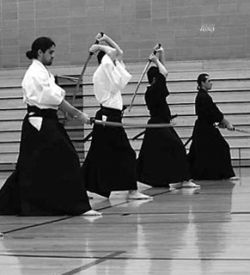
Iaido means 'the art of the sword,' and involves learning the appropriate techniques for drawing a samurai sword (an iaito), making clear and precise cuts against imagined opponents, while portraying a level of zanshin (roughly a conciousness and energy), for certain scenarios (kata).  These scenarios stemmed from various attacks that a samurai may have encountered and had to defend against in his daily life in Japan during the Edo (and similar) period.  It does not involve attacking actual people.  For that, look into kendo, which uses body armor (bogu) and bamboo 'swords' (shinai).  Kendo also comes with a lot more bruises than Iaido, so keep that in mind.

Iaido is like this, but with
more 'wooshing' sounds
The best part of Iaido, in my opinion, is that it's very easy to let non-Iaido things slip out of your mind when you're doing the kata.  You have to have a LOT of focus to do the moves correctly, as it's not just where you swing the sword, but how you swing it, your stance, your 'energy,' etc.  It's also a decent low impact workout, and the people who do it are generally interesting people who are fun to hang out with.

The worst part is probably that it requires constant training if you want to be any good at it.  It's not really something you can pick up for the month, put down for six months, and pick back up for a month.  Like any martial art, to learn Iaido you likely need to find a school to join (run by a sensei), attend regularly, pay school dues, and practice outside of class.

Iaido has low initial startup costs, as you can practice in gym clothes (no shoes) and use a wooden sword called a bokken ($15?).  Many schools will let you practice with these for the first few classes until you decide that Iaido is something you want to continue to pursue.  When you get more into it, you can spring for the metal iaito sword ($100 - $1000+), and the samurai clothing (a gi and a hakama, $100+ for both).  The main expense from week to week will be the class fees, which could be free (unlikely), or could be  more than $50/week.  Finding an instructor may also be a challenge depending on where you live.

3. Home-Brewing Beer 
So let me say up front that I don't drink a lot of beer.  I drink beer, I just don't drink a lot of beer.  This, apparently, is not a good trait for being a home brewer, as you will quickly end up with hundreds of bottles (literally) of beer that you won't be able to possibly drink yourself, and with friends who are tired of drinking your homebrew beer.  That said, I attended a party where someone brought some homebrew beer, and I was intrigued.  It seemed like an interesting hobby where you could get creative and tweak recipes to brew what you liked.  When I got the opportunity some time later to purchase my own homebrew kit, I dove in.

It's best not to think
about what this looks
like and just appreciate
the finished product...
Homebrewing is a fairly simple process, but involves a lot of steps that are all equally important to getting a tasty (or at least drinkable) resulting beer.  The process starts by making what is essentially a hot soup of sugary liquid (whether extracting it from grain yourself, or buying pre-made sugar extract), bringing it to a boil with a lot of water, adding specialty grains to give flavor and color to the mixture, throwing in hops at certain times during the boil to give bitterness, taste, and aroma, cooling the mixture down, adding specialty yeast, and putting everything in a large glass bottle (carboy) or plastic bucket to sit for a few weeks while the yeast turns the sugary liquid (called wort) into beer.

The best part of homebrewing I think is the ability to customize your recipes to what suits your tastes.  For example, I'm a fan of big malty beers, so I tweak recipes for barleywines, porters, and stouts.  Other homebrewers love hops, and so they focus on brewing beers like IPAs.  Thus, you can make what you like, and in fairly large quantities, for about the same cost as buying beer in the store.  This gives you a creative outlet to make, tweak, and try out different recipes, and you have a tangible product at the end of it (albeit about a month later) that you can hold in your hand and say "I made this!"

The worst part of homebrewing, probably, is that you don't actually 'save' any money by homebrewing.  For instance, a good recipe for a high alcohol beer might cost upwards of $50 in ingredients, and produce about 4 cases (48 bottles) of beer, for a cost of a little over $1 per bottle.  That's not that much less than buying decent microbrew ($8/6 pack?) and is a lot more expensive than buying a 30 pack of cheaper beer.  Actually, if you want to brew a basic America Lager (think Budweiser or Coors), you're going to end up spending significantly more money than if you had simply bought the same type of beer in the store.  It also takes a lot of patience to brew the wort (5+ hours?), and then wait for the beer to ferment in the carboy or bucket (2-3+ weeks).  So if you're one of those 'immediate gratification' people... well.. you probably shouldn't be in a Ph.D. program for one, but you also will probably find it hard to homebrew, for two.

"After I had to mortgage my house to afford
all of my homebrew equipment, my wife left
me and took the kids.  BEST DAY EVER!"
Homebrewing has moderate startup costs, as you can get a startup 'kit' for around $100 (or more, depending on how fancy you want to make it).  The kit will come with a couple brewing buckets, hoses and other tools, and a basic ingredient kit (you supply a large pot).  You can also buy ingredient kits for a basic low alcohol beer for around $30-$40, more if you want something like a Barleywine, Stout, or Porter.  You can also customize your homebrew setup with larger brew pots, more carboys or buckets, higher quality tools, etc., so you can quickly drop a LOT of money into homebrewing if you're not careful.  If you stick with the basic setup, then you can figure somewhere between $30 and $60 per 5 gallon (~48 bottle) batch of beer.


"My 'hobby' is academic research... as well as
heart attacks... lots and lots of heart attacks."
In conlusion: There are plenty of other hobbies out there that range from costing almost nothing (e.g., hiking, volunteering, blogging), to being very expensive (e.g., collecting antiques, skydiving); that range from being relatively quick (swimming, working out) to relatively slow (knitting, reading).  The trick is to find something that interests you, fits in your budget (both in terms of time and money), and gives you a way to get away from academia, if only for a little while.  Having a non-academic-related hobby will help keep you sane, make you well-rounded, and give you perspective.  I highly recommend everyone taking up something of interest to them that is outside of the academic world.
--------------------------------------------
Picture Credits: Tweak Jaws Kayaking Iaido_1 Iaido_2 Carboy Beer_Dad Professor_Heart_Attack