Showing posts with label sanity. Show all posts

Friday, May 18, 2012

On Wiser People and Doubts


"The whole problem with the world is that fools and fanatics are always so certain of themselves, but wiser people so full of doubts." 
Bertrand Russell

This is probably one of my most favorite quotes of all time.  It also, I think, accurately reflects much of what happens when you have earned (or are in the process of earning) a Ph.D.

The Ph.D. process is meant to make you both a jack of some trades and a master of one.  That is, you are expected to have a general knowledge about an entire field (basic as that knowledge may be), but also to become one of the (if not THE) worldwide experts on a little, tiny bit of subject matter within your field.

For instance: Because of my dissertation work, I am probably now one of the top researchers on the one specific type of policy that my dissertation examined, at least to the handful of academics that actually care about said policy.

...You have no idea how many times I revised that last sentence because I thought it was stretching the truth, changing, adding, or deleting phrases such as "top five", "top ten", "maybe" "definitely", "probably", "in America", "I can state with confidence", etc. etc. etc.).  In the end, I still pussed-out and added the "at least to..." clause to the sentence. That, right there, is part of the problem.

"I am an expert on my own dissertation topic!!!"
That is, this provides an excellent example of what Bertrand Russell was talking about.  The more knowledge you have about something, the less confident you feel about your abilities. (Conversely, 'fools and fanatics' are absolutely certain of their talent and abilities.)

This feeling is referred to as impostor syndrome, and I've also seen it referred to as the 'phony police' (as in, the phony police are going to come and arrest me for being a phony scholar).  Even writing a sentence on my own personal blog about something that is probably more true than not (that I'm an expert on my own damn dissertation topic) requires me to put in tons of qualifiers until I feel comfortable typing it.  In truth, the sentence as is still makes me feel a little uncomfortable, but as Bill O'Reilly said: "F*ck it!" (video link, nsfw language).

He made it through grad school
...without experiencing any
feelings of inadequacy.
Now I'm sure there are people who finish their dissertations and never experience any self doubts about their abilities as a scholar.  I've just never met any of those people, and like the majestic Sasquatch, the only evidence that they exist are blurry photos and television shows.  (Side note: Those people are typically referred to as 'assholes').  I'm also willing to bet that feelings of inadequacy/'faking it' are more common among Ph.D.s. (and especially Ph.D. students) than not.  This is one reason why I tell my friends in grad school that it takes at least three years to realize you're not a complete idiot.  (You still feel like a phony, just not so much of an idiotic one).  As such, it seems that it's normal to think of yourself as 'faking it', which really isn't of much consolation.

Giving a Hammer to a Ph.D.
On a related note, in researching for this post, I came across an article on how to spot a 'fake' Ph.D. (that is, someone who got their degree from a diploma mill).  One thing in the article jumped out at me: "Give a hammer to a phony Ph.D. and he'll treat everything he sees as if it is a nail. Trained minds don't do this."  I get what the author is saying: Fake Ph.D.s think they know everything about anything, and their research findings are more important (and more generalizable) than they really are.

However, I think the reverse is true as well: "Give a hammer to a 'real' Ph.D. and he'll realize that his hammer is only good on certain nails, used on certain boards, under certain environmental conditions, which will never actually be in the same location at the same time. Sane minds don't do this."  

That is, during the Ph.D. process you're taught to cite anything you say that could possibly be attributed to someone else.  You have to qualify statements with phrases such as "The evidence suggests that...", and "While not confirmatory, it appears that..."   As such, I think you internalize the idea that you aren't an original thinker, and are not a 'real' scholar who is able to be an 'expert' on something. (Or maybe not.  Again, who the f*ck am I?)

Constant Judging as Part of the Process
"I've seen better
theoretical models
selling toothpaste
on TV!  Hrumph!"
It also doesn't help that every aspect of obtaining your Ph.D. degree
(classes, comps, dissertation) involves being judged by 'senior' members of the field.  Even after you become a Ph.D., most of your work is subject to peer-review from anonymous 'experts' in your field (and given the low acceptance rates from top journals, is subject to frequent rejection from those same experts).   The entire process of getting a Ph.D. and being an academic involves multiple and repeated cases of being judged by someone with *supposedly* more knowledge than you have, about your work on a topic that you're supposedly an expert scholar in.  (Hence the title of this blog).  All of this leads to a very f*cked up view of your own abilities, and frankly, is extremely exhausting.

Semi-related note: This post also helps shed light onto one of the reasons my posting schedule is infrequent and completely random.  I swing between the extremes of "Hey, I know what I'm talking about!  Maybe I should post something that might help someone in the future!" to the other end of "Post on a academic topic?  Who the f*ck am I?  A nobody who couldn't tell his ass from a hole in the ground!"  Unfortunately, the latter kinds of feelings are (still) more frequent than the former.  I'm still working on getting over this, and I'm not sure I'll ever really be free of these feelings/thoughts. (However, buying and drinking good quality beer seems to help just a little bit).

That's not entirely true. I can, in fact,
tell my ass from a hole in the ground.
[Insert joke about being full of crap]

----------------------------------------------------------------------------------------
Image Credits: RussellO'Reilly, The Most Interesting Man in the World, Hole

Note: The actual Russell quote is: "The fundamental cause of the trouble is that in the modern world the stupid are cocksure while the intelligent are full of doubt."  It is from Russell's 1933 essay "The Triumph of Stupidity".  However, I think the paraphrased version is easier to understand and more snappy.

Sunday, August 28, 2011

Having a creative outlet outside of academia

Yes, when I get stressed, I basically
turn into Tweak from Southpark.
One of the things I think is incredibly important for making it through grad school (and hopefully through the tenure track) is to have a creative outlet that doesn't involve academia.  These outlets let you get away (even temporarily) from thinking about classes, about the dissertation, about teaching, about publications, about the job market, and all of those other things that caused my eyelid to twitch from thinking about them too much. (Seriously, the eyelid twitch is God's way of saying "Look, you've got to calm down before I give you a stroke.")

When I was in grad school I had a number of different hobbies, some short-lived, some not, that let me escape from the grad school, homework (when I still had classes), research, and academia in general.  Due to my self-diagnosed hobby A.D.D., the assortment of things I used as creative outlets and general stress relievers was pretty varied. Here's a list of three things I did (and may still do from time to time), along with the reasons I found them to be enjoyable, and things to consider if you wanted to take any of these up in the future.

This is why I hate swimming.
Thanks Speilberg.
1. Kayaking
My wife and I took up kayaking after her parents took us kayaking a couple times during a summer visit. While I am not a strong swimmer, and generally am terrified of swimming in natural bodies of water (holla back if you saw Jaws as a six year old as well!), I found I actually enjoyed floating on top of the water, and being able to easily control where the kayak went.

The best part of kayaking, I think, is being forced to go out into nature and actually do something.  Kayaking gets you out of the house, let's you see and explore the natural surroundings in your area, and is very relaxing. Note that I am not talking about whitewater kayaking, which requires a helmet, fast moving water, an updated will, and the ability to not freak the f*ck out when you flip over and are strapped into your death trap of a boat. I don't think I would find that relaxing, and since I'm allergic to drowning, I don't think I'll be trying it anytime soon. Rather, I'm talking about kayaking on slow moving rivers and calm lakes.

Yeah... not this kind of kayaking...
The worst thing about kayaking is it's very weather dependent, and in the northeast that means about six months of the year it is too cold (or frozen) to go, and is also a no go when it's raining.  The startup costs are also one of the downsides, at least initially.

Kayaking has pretty high startup costs, especially if you want to buy your equipment and not rent it every time from someplace like L.L. Bean (which gets expensive quickly anyway).  A good entry level kayak will start at about $250, and you'll need a paddle ($50), a life vest ($25+), a carrier of some type for your vehicle ($50-$200), associated straps and ropes ($25), and things like dry bags ($10-$30) and other accessories.  It will probably cost at least $500 to get into kayaking (per person, if you go in as a couple like my wife and I did).  The nice thing is once you've bought your stuff, the actual kayaking trips will be virtually free, minus gas to drive places and maybe admission to state parks.

2. Iaido
My friend Matt convinced me during my first year in the Ph.D. program to join him for an iaido class. His sales pitch was basically "Do you like swords? You get to swing them around in Iaido."  Since I do, in fact, like swords, and wanted to swing them around without someone calling the po-po, I decided to give it a try.

Thanks to Iaido, I can theoretically
defend myself in this situation.
Very useful on the college campus.
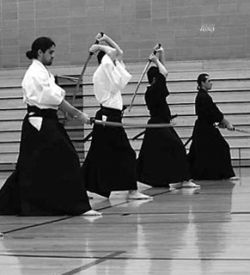
Iaido means 'the art of the sword,' and involves learning the appropriate techniques for drawing a samurai sword (an iaito), making clear and precise cuts against imagined opponents, while portraying a level of zanshin (roughly a conciousness and energy), for certain scenarios (kata).  These scenarios stemmed from various attacks that a samurai may have encountered and had to defend against in his daily life in Japan during the Edo (and similar) period.  It does not involve attacking actual people.  For that, look into kendo, which uses body armor (bogu) and bamboo 'swords' (shinai).  Kendo also comes with a lot more bruises than Iaido, so keep that in mind.

Iaido is like this, but with
more 'wooshing' sounds
The best part of Iaido, in my opinion, is that it's very easy to let non-Iaido things slip out of your mind when you're doing the kata.  You have to have a LOT of focus to do the moves correctly, as it's not just where you swing the sword, but how you swing it, your stance, your 'energy,' etc.  It's also a decent low impact workout, and the people who do it are generally interesting people who are fun to hang out with.

The worst part is probably that it requires constant training if you want to be any good at it.  It's not really something you can pick up for the month, put down for six months, and pick back up for a month.  Like any martial art, to learn Iaido you likely need to find a school to join (run by a sensei), attend regularly, pay school dues, and practice outside of class.

Iaido has low initial startup costs, as you can practice in gym clothes (no shoes) and use a wooden sword called a bokken ($15?).  Many schools will let you practice with these for the first few classes until you decide that Iaido is something you want to continue to pursue.  When you get more into it, you can spring for the metal iaito sword ($100 - $1000+), and the samurai clothing (a gi and a hakama, $100+ for both).  The main expense from week to week will be the class fees, which could be free (unlikely), or could be  more than $50/week.  Finding an instructor may also be a challenge depending on where you live.

3. Home-Brewing Beer 
So let me say up front that I don't drink a lot of beer.  I drink beer, I just don't drink a lot of beer.  This, apparently, is not a good trait for being a home brewer, as you will quickly end up with hundreds of bottles (literally) of beer that you won't be able to possibly drink yourself, and with friends who are tired of drinking your homebrew beer.  That said, I attended a party where someone brought some homebrew beer, and I was intrigued.  It seemed like an interesting hobby where you could get creative and tweak recipes to brew what you liked.  When I got the opportunity some time later to purchase my own homebrew kit, I dove in.

It's best not to think
about what this looks
like and just appreciate
the finished product...
Homebrewing is a fairly simple process, but involves a lot of steps that are all equally important to getting a tasty (or at least drinkable) resulting beer.  The process starts by making what is essentially a hot soup of sugary liquid (whether extracting it from grain yourself, or buying pre-made sugar extract), bringing it to a boil with a lot of water, adding specialty grains to give flavor and color to the mixture, throwing in hops at certain times during the boil to give bitterness, taste, and aroma, cooling the mixture down, adding specialty yeast, and putting everything in a large glass bottle (carboy) or plastic bucket to sit for a few weeks while the yeast turns the sugary liquid (called wort) into beer.

The best part of homebrewing I think is the ability to customize your recipes to what suits your tastes.  For example, I'm a fan of big malty beers, so I tweak recipes for barleywines, porters, and stouts.  Other homebrewers love hops, and so they focus on brewing beers like IPAs.  Thus, you can make what you like, and in fairly large quantities, for about the same cost as buying beer in the store.  This gives you a creative outlet to make, tweak, and try out different recipes, and you have a tangible product at the end of it (albeit about a month later) that you can hold in your hand and say "I made this!"

The worst part of homebrewing, probably, is that you don't actually 'save' any money by homebrewing.  For instance, a good recipe for a high alcohol beer might cost upwards of $50 in ingredients, and produce about 4 cases (48 bottles) of beer, for a cost of a little over $1 per bottle.  That's not that much less than buying decent microbrew ($8/6 pack?) and is a lot more expensive than buying a 30 pack of cheaper beer.  Actually, if you want to brew a basic America Lager (think Budweiser or Coors), you're going to end up spending significantly more money than if you had simply bought the same type of beer in the store.  It also takes a lot of patience to brew the wort (5+ hours?), and then wait for the beer to ferment in the carboy or bucket (2-3+ weeks).  So if you're one of those 'immediate gratification' people... well.. you probably shouldn't be in a Ph.D. program for one, but you also will probably find it hard to homebrew, for two.

"After I had to mortgage my house to afford
all of my homebrew equipment, my wife left
me and took the kids.  BEST DAY EVER!"
Homebrewing has moderate startup costs, as you can get a startup 'kit' for around $100 (or more, depending on how fancy you want to make it).  The kit will come with a couple brewing buckets, hoses and other tools, and a basic ingredient kit (you supply a large pot).  You can also buy ingredient kits for a basic low alcohol beer for around $30-$40, more if you want something like a Barleywine, Stout, or Porter.  You can also customize your homebrew setup with larger brew pots, more carboys or buckets, higher quality tools, etc., so you can quickly drop a LOT of money into homebrewing if you're not careful.  If you stick with the basic setup, then you can figure somewhere between $30 and $60 per 5 gallon (~48 bottle) batch of beer.


"My 'hobby' is academic research... as well as
heart attacks... lots and lots of heart attacks."
In conlusion: There are plenty of other hobbies out there that range from costing almost nothing (e.g., hiking, volunteering, blogging), to being very expensive (e.g., collecting antiques, skydiving); that range from being relatively quick (swimming, working out) to relatively slow (knitting, reading).  The trick is to find something that interests you, fits in your budget (both in terms of time and money), and gives you a way to get away from academia, if only for a little while.  Having a non-academic-related hobby will help keep you sane, make you well-rounded, and give you perspective.  I highly recommend everyone taking up something of interest to them that is outside of the academic world.
--------------------------------------------
Picture Credits: Tweak Jaws Kayaking Iaido_1 Iaido_2 Carboy Beer_Dad Professor_Heart_Attack